
The Walker County Court Calendar
The LMJC calendar page is the main circuit starting point. It links the Walker calendar, a court-administrator Google calendar, and a PAC calendar. The annual circuit PDF groups dates by court and event type. Separate Walker criminal arraignment and civil-hearing reports add case-level fields. Each source answers a different scheduling question, and none is a complete case history.
The current calendar page can also carry time-sensitive notices, such as a specialty-court cancellation or training notice. Because those items change, readers should use the source page itself rather than rely on a saved copy. Municipal courts keep separate schedules, so a city citation may never appear on the circuit calendar.
Start With Current LMJC Calendars
The annual LMJC calendar supplies the broad map. Walker labels include arraignment, criminal calendar call, criminal pleas, motions, status, criminal jury trials, civil jury trials and general jurisdiction, child-support-related sessions, Drug Court, and probation or parole calendars. These labels identify scheduled session types. They are not docket entries or outcomes.
The official calendar index shown here keeps the Walker and administrator routes together.
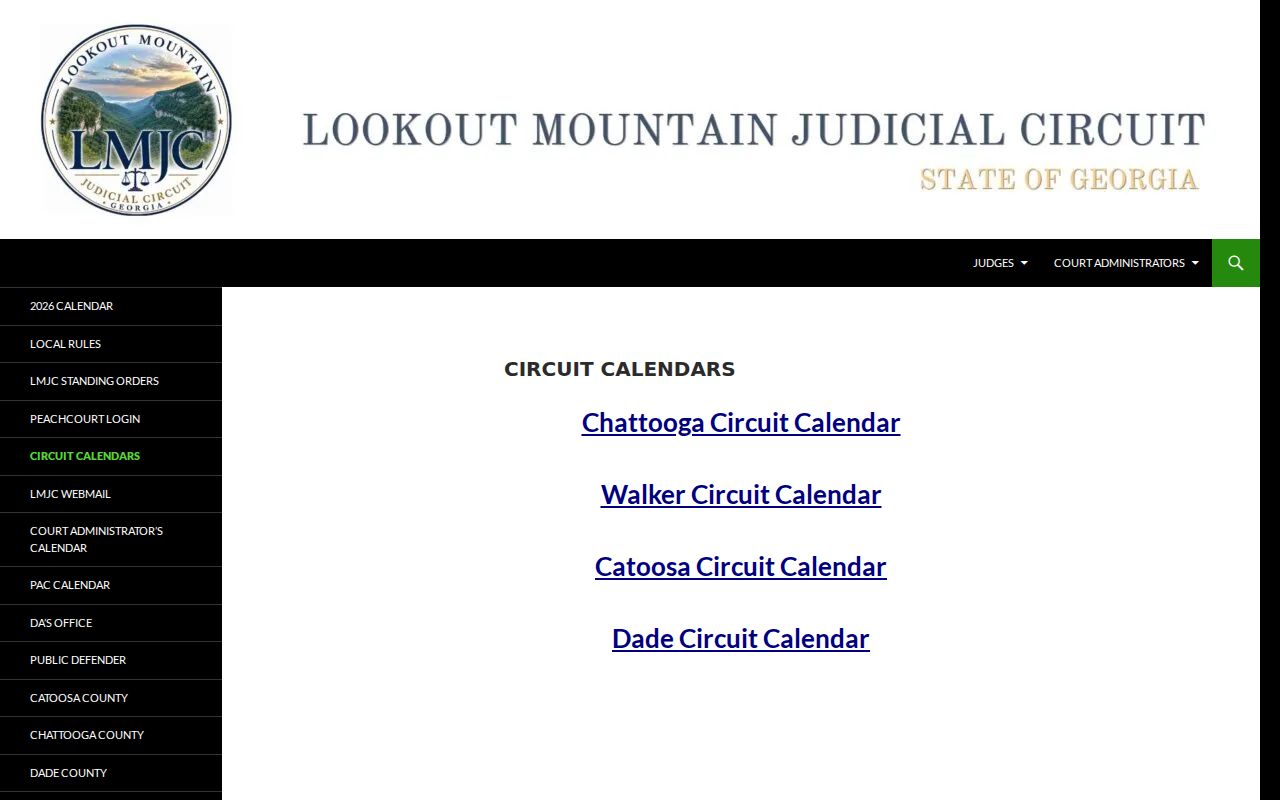
The linked index is more reliable than a bookmarked old PDF because it can point to the court's current posting and notices.
How to Find Your Court Date
Start with the court named on the notice, citation, bond paper, or filing. For Superior or State matters, compare the LMJC calendar with the docket through the county clerk route or PeachCourt. For Magistrate, Probate, Juvenile, or municipal matters, use that court's office. The county clerk portal was unavailable during the research check, so telephone or counter confirmation remains essential.
- Open the current official calendar or court-specific portal.
- Match the court and official case reference, using only authorized data.
- Read the newest date, time, judge, category, and notice.
- Confirm the setting with the clerk, administrator, or attorney before attending.
All documented channels matter. Call the Clerk of Superior Court at 706-638-1742 for Superior or State file routing. Check courthouse or courtroom postings and docket call when directed. Ask the party's attorney about the controlling notice. Fort Oglethorpe also offers its own CourtWare calendar and a notification workflow for city tickets. No reminder replaces a court order.
Walker Calendar Reports Differ
The Walker arraignment report identifies Superior Court, the session, judge, date, time, attorneys, count, case number, offenses, and page. The civil-hearings report identifies date, time, parties, case number, cause of action, attorneys, comments, and page. The annual calendar focuses on blocks of scheduled court work rather than detailed rows.
This difference prevents a common mistake. A broad circuit date may show that criminal motions are planned, while a case report or docket identifies the matter. Conversely, a case may appear in a report but later be continued. Use the broad calendar to orient the search and the newest case-specific source to verify it.
Reading a Court Setting
Read the report header before any row. It identifies the court, calendar type, and often the judge or report name. Then confirm that the date and case reference match the official notice. Do not copy live party rows into notes that may be shared.
| Date | The scheduled day, not the filing date or proof that the event occurred. |
|---|---|
| Time | The listed session time, which may be a calendar call rather than an individual hearing time. |
| Judge or court | The assigned court context shown by the report header. |
| Case reference | The official case number used to match the docket. |
| Setting type | Arraignment, motions, pleas, status, civil hearing, calendar call, or trial session. |
Walker Shorthand Is Not Outcome
- Arraignment
- An appearance where charges, a plea, and procedural rights may be addressed. It does not establish guilt.
- Calendar call
- A scheduling or case-management session, not necessarily a trial.
- Motions
- A session concerning filed requests. The label does not show the ruling.
- Status
- A check on case posture or readiness.
- Jury trial
- A planned session type, not proof that a jury was seated or reached a verdict.
Resets, Continuances, and Cancellations
A continuance moves a setting by court order or approved process. A reset can place the matter on a later calendar. Cancellation removes or changes the planned session, but an old PDF may stay online. The current LMJC page has carried notices about canceled specialty-court activity, which shows why the index and latest order matter.
Do not assume that a missing row means the case ended. It may have moved, resolved, been removed from that report, or shifted to another calendar. Check the docket for a later notice or order. Then call the clerk or administrator and ask whether the date, time, building, and courtroom remain current. Only the court can change a setting.
Walker Rules Shape Calendar Practice
The Lookout Mountain Judicial Circuit publishes both local rules and standing orders. Those materials sit behind many calendar decisions. The local-rules page links the current circuit rules, while the standing-orders page covers case management, domestic relations, assignment, administrative topics, and other court instructions. A standing order is a continuing direction from the court. It can govern procedure for a group of cases without appearing as a unique explanation beside every calendar row.
Before treating a date as the only instruction, review any order filed in the case and the applicable LMJC local rules. A scheduling order may set deadlines that do not appear on the public annual calendar. Domestic-relations or specialty matters may also follow a named standing order. The calendar identifies the session, while the order controls what a party must file, bring, or do.
Requests for an interpreter offer a practical example. LMJC provides an official interpreter request form, and the circuit page says to submit a request at least ten business days before the hearing. That lead time is not visible merely from a date row. Anyone who needs an accommodation or interpreter should use the official court process promptly and confirm receipt. A calendar lookup alone does not make the request.
Fort Oglethorpe Uses CourtWare
Fort Oglethorpe maintains a separate municipal calendar interface. Its visible columns include Court Date/Time, Name, Violation Date/Time, Case Number, Ticket Number, Violation Code, Payment Link, Court Date Type, and violation description. Those city fields should not be projected onto Walker Superior or State reports.
The official CourtWare calendar interface is shown without relying on a live private row.
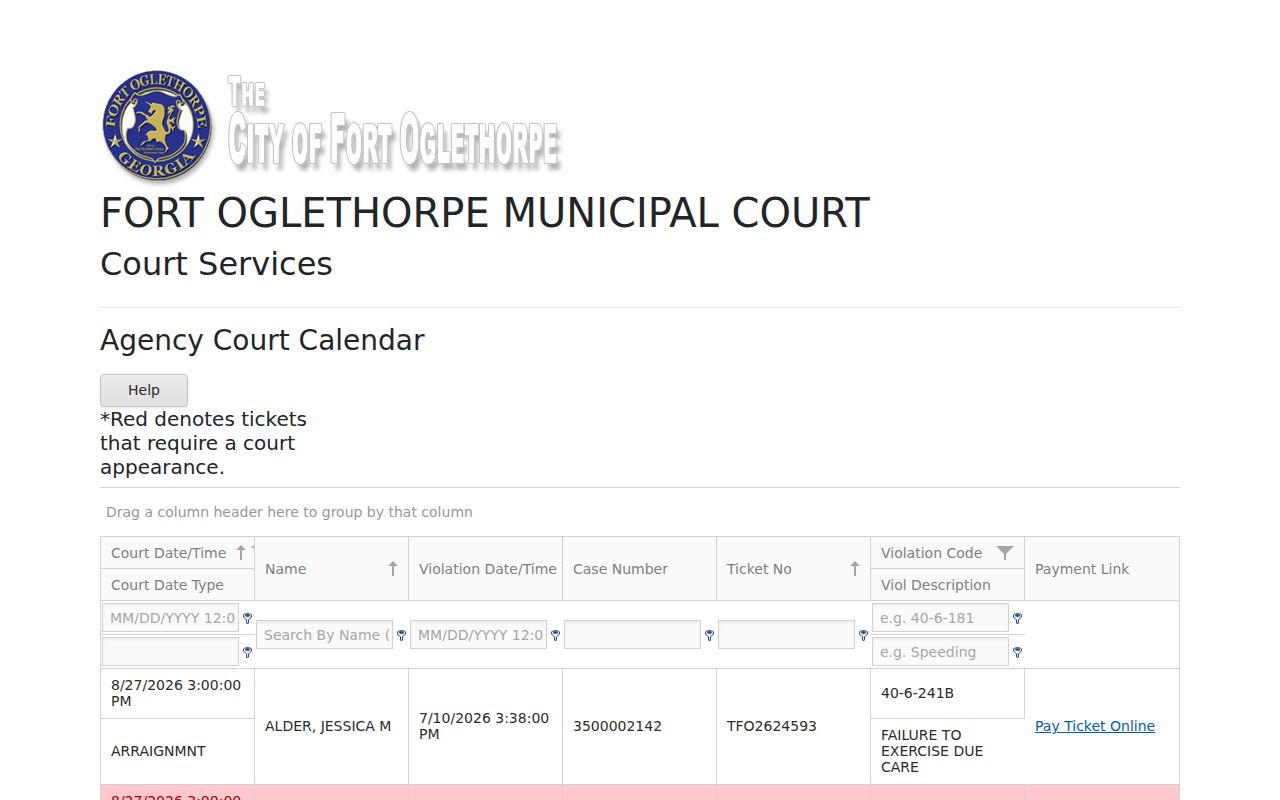
This separate tool confirms the larger rule: use the city court's calendar for a city case and the LMJC route for circuit settings.
What To Do If You Miss a Setting
Contact the correct clerk and any attorney at once. Give the official case or citation reference and ask for the current status and next authorized step. Do not simply appear in a courtroom without checking, and do not assume an online payment will erase a missed date. Municipal and Sheriff citation processes can have their own failure-to-appear consequences.
Missed a setting? A missed date can lead to a failure-to-appear action, warrant, bond consequence, or license-related action depending on the case.
Call the maintaining clerk or court immediately and speak with counsel when represented.
A Georgia lawyer can advise how to address the missed Walker County setting before any unscheduled appearance.
Superior and State record questions can begin with the clerk at 103 South Duke Street, LaFayette, GA 30728, phone 706-638-1742. Magistrate is at 201 South Duke Street, phone 706-638-1217. City tickets go to the named municipal clerk. Juvenile matters use the Juvenile Court office, and federal matters use the Rome Division. The court on the notice controls.